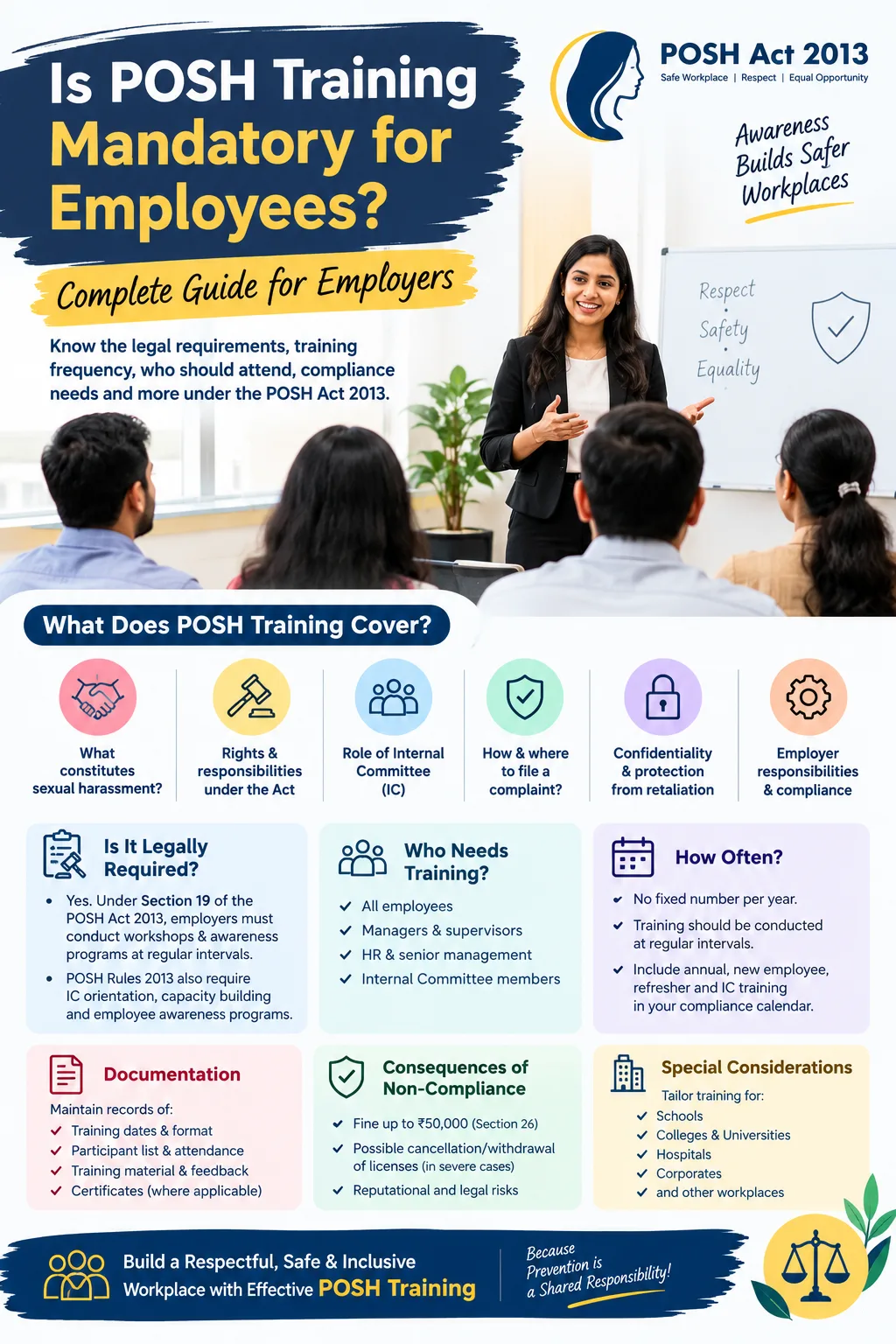
Is POSH training mandatory for employees in India? Learn what the POSH Act 2013 requires from employers, how often POSH awareness training should be conducted, who needs training, Internal Committee (IC) training requirements, compliance documentation, penalties for non-compliance, and practical POSH training guidelines for corporates, schools, colleges, hospitals and other workplaces.
Is POSH Training Mandatory for Employees?
Complete Guide for Employers
One of the most important questions that the employers ask related to POSH Act is: ‘Is POSH training legally mandatory?’
Under the sexual harassment of women at workplace (Prevention,Prohibition and Redressal) Act 2013, every employer has a statutory duty to organize workshops, awareness, programmes, trainings, and orientations at regular intervals in order to sensitize the employees about the provisions of the act.
The POSH Rules, 2013. Further required employees to conduct employee awareness programmes, orientation programmes, seminars for internal committee, members and capacity building and skill building programmes for the committee. Therefore, it is very important to note that POSH training should not be treated merely as an optional HR activity or a one-time formality, it forms an important part of an employer statutory obligation and compliance framework. It is to be noted that the law states that these trainings and orientation should be conducted at regular intervals. Therefore, it means that the organization should create a continuing POSH awareness and training mechanism appropriate to their workforce and workplace.
What is POSH training?
POSH Training is a structured awareness and capacity building program designed to help employees and organizations to understand some concepts like
- What constitutes sexual harassment?
- What behavior may amount to inappropriate workplace conduct?
- Rights and responsibilities under the POSH Act
- How and where a complaint can be made?
- The role of internal committee
- The responsibilities of managers and supervisors
- Confidentiality requirements
- Protection against retaliation
- The inquiry process
- Employer responsibilities
These training should not merely consist of reading out the organizations policy, rather it should help employees understand how the law applies to the real workplace situation
Is POSH training legally required?
What does the POSH act say?
Section 19 of the act sets out certain duties imposed upon an employer. Section 19(c) requires that every employer
- Should organize workshops and awareness programmes at regular intervals for sensitizing the employees about the provisions of the act
- Organize orientation programmes for the members of IC in the manner prescribed
Further, the POSH rules 2013 provide further details
Rule 13 requires employers to undertake among other things
- Orientation programs and seminars for internal committee members
- Employee awareness programmes
- Forums for dialogue
- Capacity building and skill building programmes for IC members
- Dissemination of organization posh policy
- Declaration of the names and contact details of IC members
- Use of a state government modules for workshops and awareness programmes where applicable
Therefore, POSH awareness and internal committee training a part of the employer statutory obligation.
Who should receive POSH training?
Training and awareness under this law should not be restricted to one department.
Different groups require different levels of training.
Employees
- All employees should understand
- What sexual harassment means?
- What conduct may constitute sexual harassment?
- Their rights and responsibilities
- How to report concerns
- Who are the internal committee members?
- Importance of confidentiality
- Protection against retaliation
- Appropriate workplace behavior
This is generally called employee awareness training.
Managers and supervisor
Managers are often the first people to hear about inappropriate workplace conduct. They should therefore understand:
- How to respond when an employee approach them
- What they should, and should not promise
- When to refer a matter to the internal committee
- Why informal handling of a complaint can create legal and procedural problems
- The importance of confidentiality
- Protection against retaliation
- Their responsibility and maintaining a safe workplace
Under any circumstances, the manager should not attempt to conduct an informal POSH inquiry, simply because an employee has approached them.
Human resources and senior management
HR and leadership teams should understand the organizations broad a compliance responsibilities. Training can come:
- Constitution of internal committee
- POSH policy
- Awareness programmes
- Complain mechanisms
- Documentation
- Annual reporting
- IC support
- Confident confidentiality
- Retaliation risk
- Implementation of recommendations
- Organizational culture and prevention
Employee awareness training
Employee awareness training is one of the most important components of POSH compliance. A good employee workshop should answer practical questions like:
- What exactly is sexual harassment?
- Can a WhatsApp message become relevant to a POSH complaint
- What about inappropriate jokes?
- What happens when conduct takes place during an office party your business trip?
- Can a client, vendor, a visitor be involved?
- What should an employee do if someone else tells them about harassment?
- Can a complaint be made electronically?
These practical questions make the post training more meaningful than just simply explaining the statutory definitions.
Employee awareness should include:
- Basic provisions of the act
- Example examples of unwelcome conduct
- Workplace scenarios
- Digital and electronic communication
- Third-party harassment
- Appropriate reporting mechanisms
- Internal committee details
- Confidentiality
- Retaliation and victimization
- Rights of the complainant and respondent
- Consequences of misconduct
- Importance of respectful workplace culture
Training for internal committee members
Internal committee training is different from that of the employee’s awareness training. An internal committee member may have to deal with a sensitive complaint and participate in a formal inquiry. Therefore, simply attending an awareness session meant for the employee does not necessarily equip an internal committee member to perform the committees’ functions.
IC training should cover:
- Constitution of inter internal committee-
- Members should understand
- Composition requirements
- Role of preceding officer
- Role of employee members,
- role of external member
- Tenure and vacancies
- Conflict of interest
Jurisdiction of the committee
- Members should understand:
- What constitutes a workplace?
- Who can be an aggrieved woman?
- Who may be a respondent?
- Workplace related situations
- Third-party situations
- Scope of the committee jurisdiction.
Complaint handling
- Training should cover
- Receiving a complaint
- Preliminary procedural steps
- Communication with parties
- Timelines
- Documentation
- Confidentiality
Enquiry procedure
- Internal committee member should be trained in
- Principles of natural Justice
- Providing reasonable opportunity to the parties
- Exam examination of evidence
- Witnesses
- Documents and electronic evidence
- Recording proceedings
- Maintaining confidentiality
- Preparing findings
- Recommendations
Orders and recommendations
- Members should understand the legal framework concerning and revolving around
- Interim relief
- Recommendations, following enquiry
- Disciplinary action
- Compensation
- Fall or malicious complaints
- Appeals
The objective here is not to simply make internal company members aware of the act. The objective is to build their capacity in order to perform their statutory role-fairly, independently and procedurally.
What is the role of employees in creating awareness?
POSH compliance is not slowly. The responsibility of the HR or internal committee. Employees also contribute to creating a respectful workplace and are equally liable for the same.
Employees should:
- Understand the organization POSH policy
- Know whom to approach when assistance is required
- Avoid inappropriate jokes, comments and behavior
- Respect professional boundaries
- Avoid retaliation against complaints or witnesses
- Maintain confidentiality
- Cooperate with lawful processes
- Avoid spreading rumors about complaints or enquiries
- Encourage a culture with concerns can be raised safely.
Awareness actually becomes meaningful when the employees understand that prevention is a shared workplace responsibility. Hence each of them is responsible in creating a safe workplace for each other.
How frequently should POSH training be conducted?
This is where the organizations often misunderstand the law.
Annual POSH training mandatory?
The POSH Act does not prescribe one universal rule stating that every organization must conduct exactly one workshop. Every year. It states that the workshops and awareness program should be organized at regular intervals. Therefore, the organization should not treat training as a one-time event under this act, a practical POSH compliance calendar may include
- Annual organization wide awareness
- New employee orientation
- Internal committee training
- Refresher programmes
- Leadership sensitization
What should a POSH workshop cover?
A professional workshop should be practical, legally, accurate, and relevant to the organization. A comprehensive employee workshop can cover.
- Understanding sexual harassment
- Understanding the POSH Act
- Workplace scenarios
- Reporting mechanism
- Confidentiality and retaliation
- Internal committee
- Interactive discussion
Why online or one time training may not be enough?
Online training can be extremely useful for certain organizations. It can help organizations reach employees across multiple locations provide standardized content and maintain training records. However, online training should not automatically be equated with complete POSH compliance
- A one-time webinar may not address
- New employees
- New IC members
- Changing workplace circumstances
- Refresher requirements
- Organization specific concerns
- Management responsibilities
- Practical enquiry skills
- Questions arising after the session
Similarly, simply sending an online video asking employees to click, I have completed the training may not actually create the meaningful awareness intended behind the enactment of this law.
A stronger and complete model should be where there is awareness, interaction, documentation, refresher, internal committee capacity building. This is how a complete and formal compliance under the act looks like.
Training records and documentation
Compliances under the act should be capable of being demonstrated through records. Organization should maintain appropriate documentation of their awareness and training activities. The recon is may include date of training, training format, trainer details, Participant list, employee, attendance session, photographs, training, material, presentations, assessment of feedback, certificates were issued, internal committee, training records, policy, circulated to employees, awareness, communications, internal committee, details, annual compliance, documentation.
Documentation is particularly important because there is a difference between “we conduct POSH Training” and being able to demonstrate “here is when we conducted it who attended it what was covered and what organization did afterwards”
Consequences of inadequate POSH compliance
POSH compliance is not merely an HR best practice. The act provides the consequences for non-compliance as well. Section 26 provides that if an employer fails to constitute the internal committee fails to take specified action under the act or contravenes attempts to contravene or an abets contravention of the provisions of this act or rules, then the employer may face a fine up to ₹50,000. This provision also contains enhanced consequences for subsequent convictions, including possible cancellation, withdraw, non-renewal of certain licenses, registration or approval as provided by Law.
Importantly, this should not be interpreted as meaning that every missed training or awareness session automatically results in a 50,000 pen. Ante, the consequences depend on nature of non-compliance and applicable legal provisions on the organization. Beyond statutory consequences in adequate implementation of the provisions of the act can create serious risks to the organization, including
- Miss handling of complaints
- Procedural errors, workplace conflict
- Loss of employee confidence
- Reputational damage
- Increase Legal exposure
- Weak documentation
Effective training their form part of risk prevention mechanism
Special considerations for schools
When it comes to school, they have a particularly sensitive workplace environment because they bring together
- Teachers
- Administrative employees
- Support staff
- Management
- Students
- Parents
- Visitors
- Vendors
- Transport personal
When it comes to POSH trainings in school. The employee awareness should cover
- Teacher to Teacher conduct
- Staff and management interactions
- Digital communication
- Parent interactions
- Workplace Events
- Field trip and travel
- Reporting mechanisms
- Internal committee responsibilities
However, a comprehensive School safeguarding program may require POSH and POCSO awareness, but the two legal frameworks should not be confused
Special considerations for colleges and universities
Higher educational institutions have a diverse environment, including
- Faculty
- Administrative staff
- Teachers
- Students
- Contract workers
- Visitors
- External collaborations
Training in these places should therefore include
- Faculty student boundaries
- Workplace and campus interactions
- Digital communication
- Research environments
- Internships
- Conferences and academic events
- Internal committee procedures
- Student facing grant mechanisms where applicable
Special considerations for corporates
Corporate workplace often has multiple layers of employment and interaction a strict compliance of the act is very much necessary in these organizations. A corporate POSH programme may need to address:
- Employees
- Managers
- Senior leadership
- HR
- Contractual workers
- Consultants
- Interns
- Clients
- Vendors
- Visitors
- Business travel
- Off-site Events
- Digital workplace
- Remote and hybrid work
For corporate which have multiple branches or locations, the implementation should also consider how awareness internal committee structures reporting channels documentations will operate across different workplaces. A single generic presentation may not be sufficient for every category of employee.
For training checklist for employers, employers can use the following checklist as a staffing point for their organization
POSH awareness
- Employee awareness programme conducted
- POSH policy communicated
- Employees informed about the internal committee
Reporting mechanism explained
- Confidentiality explained
- Retaliation and victimization discussed
Internal committee
- IC properly constituted
- IC members identified
- IC members oriented
- IC members receive capacity building
- IC members understand enquiry procedure
Documentation
- Attendance records maintained
- Training material preserved
- Training dates recorded
- Participant details maintained
- Certificates issued where appropriate
- Feedback/assessment documented were used
- Annual compliance records maintained
Continuous awareness
- New employees receive POSH orientation
- Refresher programs considered
- New IC members trained
- Management sensitized
- Compliance periodically reviewed
Common mistakes, employers should avoid
- Treating POSH training as a tick box exercise
- Conducting only one session and stopping
- Training employees, but not the internal committee
- Assuming that the POSH policy is enough
- Giving certificates without maintaining records
- Using generic examples and related to the workplace
- Ignoring managers
- Treating POSH as a women’s issue only
How can employers build an effective POSH Training Programme
Step one: assess
Step two: educate
Step three: train the internal committee
Step four: document
Step five: review
POSH training in Lucknow
For organizations looking for POSH training in Lucknow Nawal Foundation provides practical POSH awareness, and compliance support for organizations, including
- Corporates
- Schools
- Colleges and educational institutes
- Hospitals
- Hotels and hospitality organizations
- Professional institutions
- Other workplace, where compliance is required
Frequently asked questions about POSH Training
Is past training mandatory in India?
The act places a statutory obligation on the employers to organize workshops and awareness programmes at regular intervals for sensitizing the employees and orientation programs for the internal committee members
Is posh training mandatory every year?
The act does not prescribe one Universal number of training sessions every year. However, it requires that workshops and awareness program should be conducted at regular intervals. The organisation should therefore develop up appropriate continuous training and awareness calendar.
Who should attend posh training?
Employees, managers, HR, personal and leadership should receive appropriate awareness or sensitisation. Internal committee members require more specialised orientation and capacity building.
Is employee training same as internal committee training?
No employee training focuses on awareness, prevention, rights, responsibilities, and reporting. I see training on the other hand requires deeper understanding of the complaint handling enquiry procedure, natural Justice confidentiality, and the committees statutory responsibilities under the act.
Is online posh workshop valid?
Online awareness programmes can be used as part of an organisation training framework. However, organisation shouldn’t ensure that online deliveries meaningful documented and appropriate to their work force rather than treating it as a simple video or attendance. Click as entire compliance system.
Can schools conduct posh training?
Yes, School should ensure that their Posch framework is appropriate for the employees, and they should also separately address the child production obligations imposed upon them under the POCSO Act.
Do hospitals need for training?
Hospitals and healthcare organisation should pay particular retention to Porsche awareness because of the diverse workforce shift based working patient facing environment, contractual staff and interactions with third parties
How can organisations arrange posh training in Lucknow?
Organisations in Lucknow and in nearby cities can contact novel Foundation for employee awareness workshops, internal committee, training management sensitisation, and a complete comprehensive compliance under the posh act